Key Takeaways
- The MIL-DTL-32630 standard provides extensive testing criteria to qualify novel conductor materials for aircraft use.
- Compared to conductor standards such as ASTM B33 and AS29606, MIL-DTL-32630 is more robust and assesses more properties of the conductor under test.
- Conductors with non-metallic cores require testing of properties that are typically considered low-risk for traditional conductors because the potential failure modes are different.
Metal conductors have been the primary (and pretty much only) means of transferring electrical energy for centuries. With recent technological developments, it is possible to use alternative materials such as nanotubes and metalized fibers as conductors. Because these non-traditional conductors rely on alternative materials, thorough testing is needed to assess their viability for high demand applications like aerospace systems.
With conductor standards like ASTM B33 (material-level specification for tin-coated soft or annealed copper wire) and AS29606 (finished-conductor specification for stranded copper, copper-alloy, aluminum, and thermocouple-extension conductors used in aerospace insulated wire) as a framework, the novel conductor types are better suited for testing in alignment with the MIL-DTL-32630. MIL-DTL-32630 is a performance specification for stranded uninsulated carbon-based conductive fiber conductors, including metalized nonconductive fibers treated as conductive fibers. As such, it carries a much broader set of qualification risks. This article reviews the requirements of these non-traditional conductors and how they align with traditional conductors.
Comparative Test Matrix
The following table lists the test methods that are called out in the MIL-DTL-32630.
Test |
Method Reference |
Acceptance Bias |
Unique to MIL-DTL-32630 |
Visual examination — workmanship / obvious defects |
Method 4.7.1 |
Must meet workmanship requirements |
No |
Diameter — finished-conductor geometry |
Method 4.7.2 |
Must meet applicable specification-sheet dimensions |
No |
DC resistance — conductor electrical resistance |
Method 4.7.3 |
Must meet specification-sheet resistance limit |
No |
Wire fusing time — overcurrent interruption behavior |
Method 4.7.4 |
Must meet specification-sheet fusing criterion |
Yes |
Tensile strength and elongation — basic mechanical performance |
Method 4.7.5 |
Must meet specification-sheet minima |
No |
Flammability — fire behavior |
Method 4.7.6 |
Must meet flammability requirement in applicable sheet |
Yes |
Flexure endurance — cyclic bend durability |
Method 4.7.7 |
Must meet minimum flex-life requirement |
Yes |
Weight loss under temperature and vacuum — outgassing/mass loss |
Method 4.7.8 |
Must meet specification-sheet limit |
Yes |
Thermal shock — resistance to rapid temperature transitions |
Method 4.7.9 |
Must meet post-shock requirement |
Yes |
Life test — durability under prescribed conditioning |
Method 4.7.10 |
Must meet life-test requirement |
Yes |
Smoke density — optical smoke output |
Method 4.7.11 |
Must meet maximum smoke-density limit |
Yes |
Smoke toxicity — hazardous combustion byproducts |
Method 4.7.12 |
Must meet toxicity limits |
Yes |
Fungus resistance — biological susceptibility |
Method 4.7.13 |
Must meet fungus-resistance requirement |
Yes |
Water absorption — moisture uptake |
Method 4.7.14 |
Must meet levels specified in applicable spec sheet |
Yes |
Salt fog — corrosion / post-exposure stability |
Method 4.7.15 |
Must meet salt-fog requirement of base/sheet |
Yes |
Resistance to fluids — direct fluid exposure durability |
Method 4.7.16 |
Public synopsis: no more than 25% loss of tensile/elongation after exposure |
Yes |
Termination crimp — termination robustness |
Method 4.7.17 |
Terminated conductor must withstand 4.7.10 life test |
Yes |
Conductor solderability — wetting of applicable conductors |
Method 4.7.18; public synopsis links to MIL-STD-202 Method 208 / MIL-STD-2223 Method 5004 |
Must meet solderability criterion for applicable conductor types |
No |
Coating workmanship — fiber metalization integrity |
Method 4.7.19 |
360-degree metal coating of individual fibers at 400X |
Similar to plating requirements |
Cross-sectional area — conductive area verification |
Method 4.7.20 |
Must meet minimum cross-sectional-area requirement |
Yes |
Temperature coefficient of resistance — resistance stability with temperature |
Method 4.7.21 |
Must meet TCR requirement in applicable sheet |
Yes |
It is important to note that these are the tests normally expected when managing novel materials, direct environmental exposure, combustion behavior, or termination risk. This is unlike ASTM B33 and AS29606 in that it is not only managing a conventional metallic conductor.
ASTM conductor specifications and AS29606 assume an established metallic strand system is tested. The MIL-DTL-32630, by contrast, covers carbon-based conductive fibers and even treats some metalized nonconductive fibers as qualifying conductors. This is why coating workmanship and TCR (thermal coefficient of resistance) matter so much. A metallic wire rarely needs a dedicated proof that every individual fiber is circumferentially metalized, but a metalized fiber bundle can lose current-carrying reliability if the coating is incomplete or electrically unstable with temperature.
Relative to metal conductor standards like ASTM B33 and AS29606, there are several tests that are uniquely MIL-DTL-32630-specific. In a way, one could argue that the MIL-DTL-32630 is more similar to the SAE AS6324, a standard for the qualification of new conductor alloys. Whereas the AS6324 seeks to gather data to determine alloy performance, it is still one more step removed from fielding a conductor than parts tested to the MIL-DTL-32630 standard.
Performance and Termination Behavior
AS29606 validates tensile, elongation, break strength, solderability, and DC resistance, but it does not evaluate the conductor’s ability to survive flex-life or termination life as a novel conductor system. MIL-DTL-32630’s concern with a broader range of conductors adds flexure endurance, life test, wire fusing time, and termination crimp because the failure modes are different. In MIL-DTL-32630’s scope, fiber breakage, resistance drift, localized current concentration, and termination-interface instability matter more than they do for conventional copper strands. The crimped termination must survive life testing, which ties conductor qualification directly to practical assembly robustness.
Regarding the different failure modes, a metalized fiber may either have breakage of the conductor coating or the fiber; loss of the coating will result in loss of the electrical continuity and loss of the fiber will result in the loss of the mechanical strength. The performance of both coating and fiber are important for these assessments.
Environmental Durability
Environmental durability is where MIL-DTL-32630 most obviously differs from ASTM B33 and AS29606. The MIL-DTL-32630 adds weight loss under temperature and vacuum, thermal shock, fungus resistance, water absorption, salt fog, and resistance to fluids. The additional tests make sense for a conductor material intended for harsh aerospace service where the conductor may be directly exposed. The fluid-resistance need is particularly important and is not part of the traditional metal conductor specifications. However, MIL-DTL-32630 does have a fluid resistance requirement to common aerospace fluids and requires that the metalized fibers are expected to retain mechanical performance after direct fluid exposure.
Safety
ASTM B33 has no flammability or smoke requirements, and AS29606 does not carry smoke-density or smoke-toxicity requirements in the conductor specification. Given that the MIL-DTL-32630 does have this requirement, it is a strong sign that the conductor itself is treated as a potential contributor to aircraft fire/smoke hazards, not merely as a hidden metallic core whose fire performance is downstream of insulation selection.
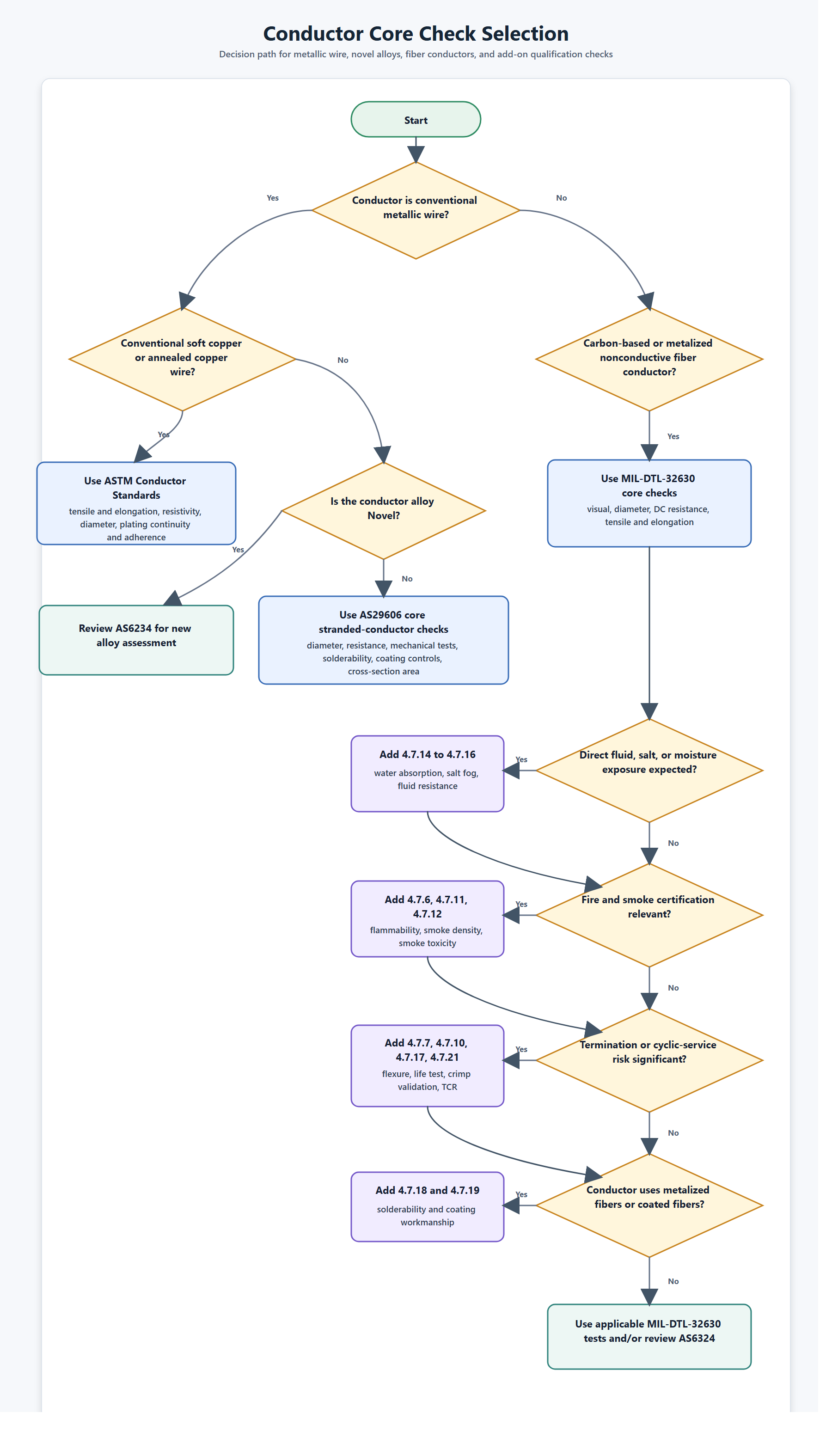
Conductor Core Check Flowchart
Divergence
Perhaps the biggest difference in methods is in coating evaluation. ASTM B33 asks whether the tin coating is continuous and adherent. AS29606 goes further for aerospace stranded conductors, requiring coating thickness verification, microsection verification for heavier-silver types after stranding, and no exposed base metal after stranding. MIL-DTL-32630’s coating-workmanship check is unique. The assessment examines whether each fiber fully and uniformly metalized in a way that preserves the current path. That is a fundamentally different question about manufacturing-control.
Conclusion
For conventional aerospace conductor procurement, the progression is clear: ASTM B33 qualifies an upstream tin-coated copper wire material, AS29606 qualifies a released aerospace stranded conductor, and MIL-DTL-32630 qualifies unconventional conductor technology, whose material architecture creates additional electrical, environmental, combustion, and termination risks. Manufacturers should, therefore, avoid treating MIL-DTL-32630 as simply “another conductor spec.” Suppliers should expect deeper qualification evidence and tighter process control with MIL-DTL-32630, and quality engineers should build their test plans around the fact that MIL-DTL-32630-specific tests are not paperwork overhead; they are the tests that close the risk gap left open when the conductor is not a conventional metal strand bundle.
For those interested in assessing their traditional and non-traditional conductor needs, contact Lectromec. Our ISO 17025 accredited lab is ready to help.

Michael Traskos
President, Lectromec
michael.traskos@lectromec.comMichael has been involved in the field of EWIS for more than two decades and has worked on a wide range of projects from basic component testing, aircraft certification, and remaining service life assessments. Michael is an FAA DER with a delegated authority covering EWIS certification, the former chairman of the SAE AE-8A EWIS installation committee, and current vice chairman of the SAE AE-8D Wire and Cable standards committee.