
Nuisance Trips
Circuit protection devices are primarily responsible for protection of electrical circuits from low impedance faults. These device types may be thermal, arc fault circuit breaker (AFCB), or integrated within a solid-state power distribution. Regardless of type, their role remains the same.
But circuit protection devices are not error free. In the cases when the circuit protection device opens the circuit without a fault being present, this is called a nuisance trip. The impact of nuisance trips can be difficult to track down and to resolve. In this article, we review common causes for nuisance trips and what the impacts can be to fleet performance.
Impacting Maintenance
First, let’s look at how a nuisance trip is presented to the maintainer. It will typically show on the circuit protection device that there has been a trip. The maintainer will then go and check the devices on the circuit, determine if there is any obvious damage, run a system check, and likely not find a fault. If the fault cannot be found, depending on the device, it may be pulled and replaced to go through the No Fault Found (NFF) cycle. It may not be until several iterations later that the reason for the issue is defined.
Obviously, nuisance trips do not come without consequences. Depending on the device and circuit being protected, the maintenance involved to determine the source can be very high. Because of this, it is important to quickly identify the cause and develop/implement a solution.
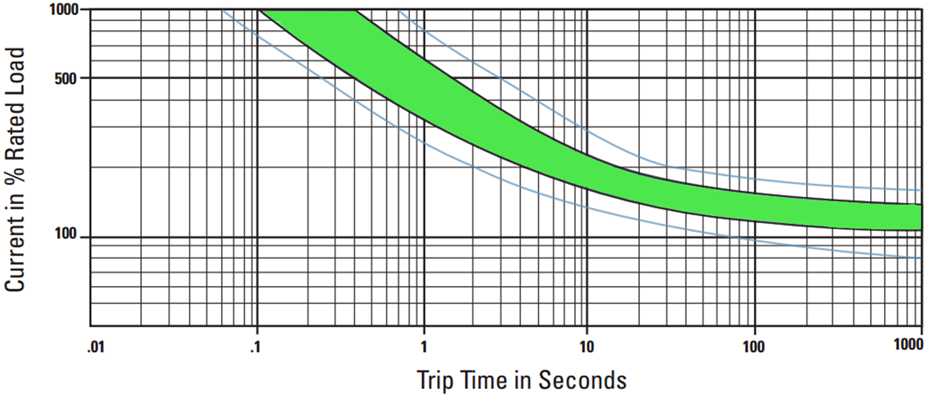
Creation of Nuisance Trips
Tracking down the cause of nuisance trips is often not easy. There are several potential causes for these interruptions in which there is not a one-size fits all solution. The following are five potential sources for nuisance trips.
- Tight control on the circuit protection: In the case, the circuit protection trip conditions can be tuned, nuisance tripping may occur when the protection is set to very stringent conditions. Any increase in current draw might cause circuit protection activation. In these cases, the circuit protection may have been fine-tuned in laboratory conditions and not on the actual aircraft.
- The load is acting normally, but the electrical signature trips the protection: As part of system integration testing, all conditions should be tested. However, with a variety of operational modes, devices produce different electrical signatures when at elevated temperatures or in a vibrational environment.
- Errors on other circuits: An example of this is considered as part of AFCB standard AS5692. In this test method, an AFCB is connected to a properly functioning circuit. In a parallel circuit protected by a thermal breaker, arc faults are initiated. The test objective is to ensure that faults that appear do not affect the operation of the AFCB protecting other circuits. However, if a protection device is too sensitive, then there is the possibility that a single fault could have an impact in other areas of the electrical system.
- The load is acting normally under different power conditions: In this case, the load is doing a good job; however, some variation in the power system appears and is propagated down the system. This voltage variation may trip the circuit protection, or it may cause the load the respond in such a way that is outside normal operation. This is not to say the device has malfunctioned, but the operation is outside of the common operation.
- Circuit protection malfunction: Some part of the circuit protection device has malfunctioned and can no longer be relied upon to protect the circuit. Each of the preceding potential causes for nuisance trips can be tied to oversensitive trip configurations. The potential response to this is to reduce the sensitivity of these protection devices, but this should not be done without consideration as to why the sensitivity was initially set to a particular level. Perhaps the circuit is connected to the fuel system and must meet the requirements of 25.981 or perhaps the threshold was set to protect the powered device. Whatever the reason, an understanding of what is being protected should be considered before changes are made.
What are Ways to Avoid Nuisance Tripping
The arc fault circuit protection standards, such as AS5692 for AC and AS6019 for DC, specify performance criteria for arc fault circuit protection devices. For integrated power controllers, the same methods can be applied for performance assessment. Showing compliance with these standards does not mean that the protection devices will be fault free, but it does reduce the chances of finding the errors later, such as during system integration or flight testing.