
Testing the Performance of AFCBs
Arc Fault Circuit Protection has been a technology that dates back to the 1990s. Despite this not being a new technology, the breath of its implementation is still limited. The device owes its inception to arcing events that occurred on in-service aircraft. Because of these events, the wiring community sought to create wiring that was arc track resistant, and the circuit protection community sought to cut off the arcing event before too much energy was released. This has been captured in the requirements of AS5692 for AC circuit protection, and AS6019 for DC protection.
Within the requirements of AS6019, is the requirement to evaluate a circuit breaker’s ability to detect and trip (open the circuit) in the case of an arcing event. Here, we review the test, what it protects, and what the results mean to those that use these protection devices.
The Setup
The arc fault circuit breaker identified in AS6019 contains a section that talks about dry arc track testing (Section 4.7.7.6.1). The setup for the test is rather rudimentary when it comes to electrical arcing (see discussions of other arcing events here). Many of the other test configurations associated with power systems and wiring require more setup and components; the AS6019 dry arc test does not.
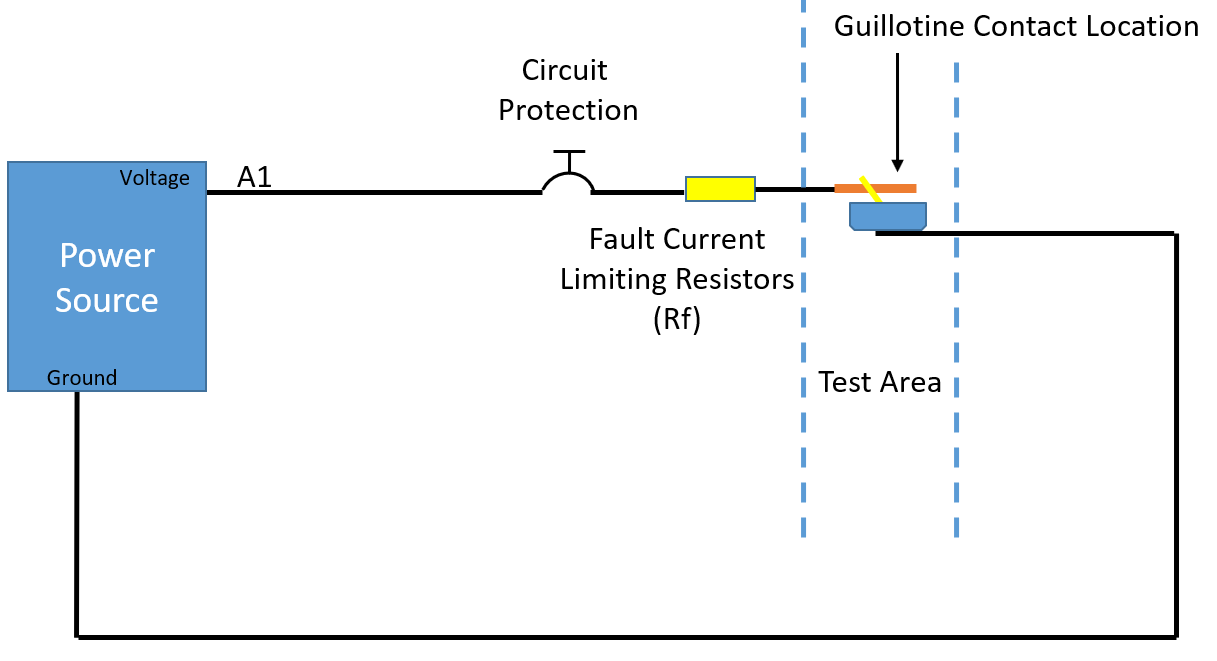
Here a fixed 28VDC power source is connected to the Device Under Test (DUT) with the specified limiting resistance between the DUT and induced fault location. In this manner, the system electrically represents what one would see in an aircraft installation with a limited resistance between the DUT and power source. The test sample is then connected to the incoming power side of the circuit and the guillotine blade is electrically grounded. The resistance between the guillotine blade and the DC source is also limited.
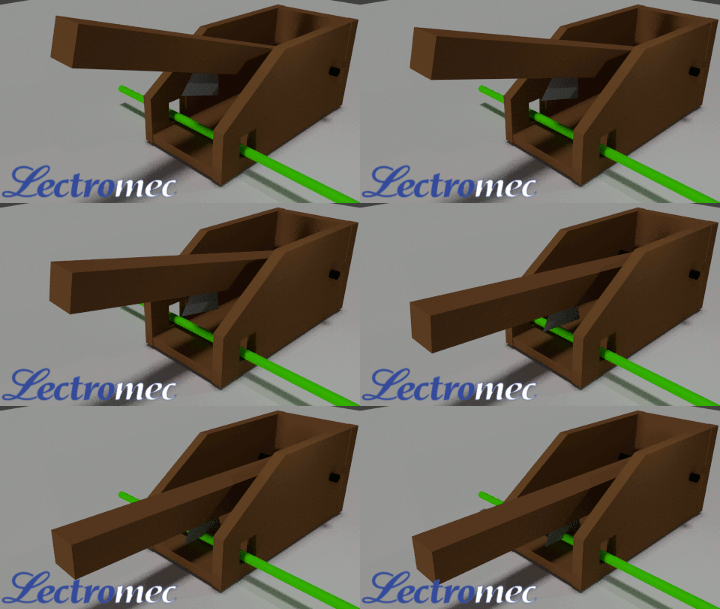
The power is applied to the system and the blade is brought down through the target wire. How the circuit protection responds to the arcing event is what this test seeks to determine.
Cutting Through
The guillotine test is one of the most basic tests of arcing. A razor blade is brought down onto a powered wire/wire harness, and the subsequent damage is evaluated. While few surfaces on an aircraft are as sharp as a razor blade, the reason for its use is that it is an easily acquirable and disposable part that produces a reasonably consistent arcing event. The thin blade is ideal because it is quickly destroyed limiting the duration of any electrical shorting event.
What are some of the results of the test?
There are only three possible outcomes from the test:
- An electrical arcing event occurs and the circuit breaker trips within the specified time. In the standard, this is within 100ms. This is the passing condition for the test.
- An electrical arcing event occurs, and the circuit breaker does not trip within the specified time. The circuit breaker has failed to properly respond and is considered to have failed.
- No arcing event occurs, or the event is too short. Repeat the test.
So why is this included in the standard?
This is included in the standard for an obvious reason: to test an arc fault circuit breaker, it is necessary to evaluate its performance in an arcing event. There is also the wet arc assessment method that is included in the test standard; this will be reviewed in another article.
Looking to the Application
While these performance characteristics are specifically called out for an AFCB, the same performance level can and should be expected for any solid-state power controller used on modern aircraft. The latest standard from the SAE power controller committee, AS4805, incorporates some elements of this technique.
Clearly the issue that always comes up with arc fault protection is the issue of nuisance trips, and it is a legitimate concern. The reliability of any system is usually limited by its most unreliable component and constant nuisance trips do not help anyone. Certainly, in the last decade, engineers working on these devices have learned the best way to protect a circuit without causing undo activation. The impact of nuisance trips was covered in a previous article.
In Review
The arc performance requirements of the AS6019 circuit protection do a great job of defining the protection that should be expected from the next generation of circuit protection. The means for testing the arcing event response of the circuit protection, while impractical from a physical configuration, create a realistic arcing event electrical signature.