Key Takeaways
- AC120-102 ensures that the FAA-approved EWIS ICAs retain their identity after being decomposed across operator-controlled artifacts.
- AC 120-102B better separates regulation requirements from AC recommendations.
- Rev B’s compatibility cross-references checklist should be integrated into the design/maintenance activities to ensure EWIS ICA deliverables are both compliant and operationally adoptable.
On June 3, 2024, the Federal Aviation Administration (FAA) issued an update to AC 120-102 (now Rev B), for incorporating Electrical Wiring Interconnection Systems (EWIS) Instructions for Continued Airworthiness (ICA) into a Part 121/129 operator’s maintenance program. Revision B is best understood as a modernization and tightening of how the guidance is framed and administered, rather than a core change to the EWIS/EZAP logic that operators and design approval holders have used. The changes in this revision and its impact on ICAs are discussed in this article.
Background and Purpose of AC 120-102
AC 120-102 exists because the FAA’s EAPAS/FTS final rule introduced aligned design and operational requirements intended to improve EWIS safety and ensure operators incorporate wiring ICA into their approved maintenance/inspection programs. The AC ties the operator’s EWIS maintenance-program obligations to 14 CFR Part 121 § 121.1111 and Part 129 § 129.111. Furthermore, the AC provides implementation guidance for those operational rules.
The AC also retains the same high-level historical rationale: wiring degradation, contamination, and wiring-related ignition/arcing hazards were highlighted by investigations into major accidents and subsequent fleet findings that degraded wiring and contamination were common. Those narratives and background sections of the AC remain materially consistent between Rev A and Rev B, with few slight changes. Perhaps the most notable change is the wording edits in the background section stating that, “Since 1959, there have been at least 18 fuel tank explosions.” With the ‘at least’ being added in Rev B.
Operationally, AC 120-102 is primarily about ensuring that the FAA-approved EWIS ICAs retain their identity after being decomposed across operator-controlled artifacts such as maintenance programs, manuals, work/job cards, and engineering authorizations/orders. That idea of traceability is central to the ACs guidance, and Rev B adds more explicit cross-links to modern FAA systems and the current organizational structure handling approvals and operator-proposed changes.
Side-by-Side Comparison of Major Changes
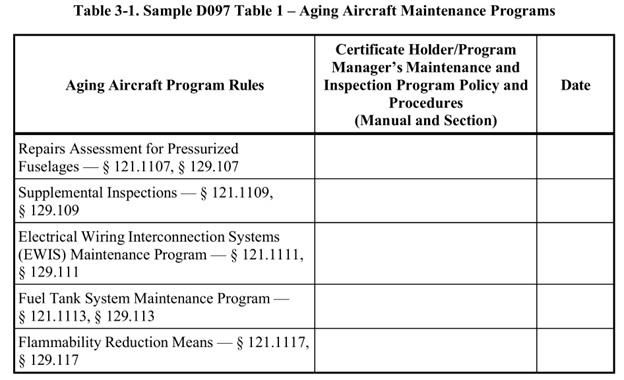
The table below highlights the most practically significant structural and substantive deltas that are visible directly in the published text (with section/page references where the wording or framing changed).
| Appendix H mapping for § 25.1729 EWIS ICA | In Chapter 1, Rev A ties § 25.1729 / § 26.11 generally to H25.5(a)(1) and (b). | Rev B adds an explicit distinction: § 25.1729 points to H25.4 and H25.5, while § 26.11 points only to H25.5(a)(1) and (b). | This is a meaningful clarification for certification teams: it reinforces that § 25.1729 (and changed-product compliance) can extend beyond the § 26.11 baseline task set. |
| Mandatory replacement times & broader EWIS ICA scope | Rev A’s “Changed Product Rule” discussion describes § 25.1729 EWIS ICA built under H25.5(a)(1)–(5) and (b), without calling out mandatory replacement times. | Rev B states § 25.1729 EWIS ICA are developed under H25.4/H25.5 and explicitly references “mandatory replacement times for EWIS components.” | Adds visibility to life-limited/mandatory replacement elements in EWIS ICA scope—relevant to certification deliverables and operator incorporation/traceability. This is perhaps becoming more important with the introduction of high voltage components. |
| D097 guidance detail | Rev A Change 1 explicitly states its “principal changes” are to paragraph 3‑6 for OpSpec D097 table usage. | Rev B retains D097 structure but adds additional explanatory “Note 2” for non-applicable rules and uses deeper subparagraph structure (3.6.1, 3.6.2, 3.6.3). | Helps standardize how D097 table and revision dates are maintained—useful for audits and for internal document-control discipline tied to EWIS ICA changes. |
| STC limitation policy memo reference | In the STC limitation section, Rev A points to PS‑AIR‑100‑2007‑12‑27A dated July 7, 2008 (and references RGL). | Rev B points to PS‑AIR‑100‑2007‑12‑27B dated June 10, 2009, and directs users to DRS rather than RGL. | For STC applicants/engineers, the “B” revision becomes the anchor policy memo reference inside AC 120-102B’s STC limitation workflow. |
| Normative language shifts (“must” vs “should”) in select operator-facing statements | Example: Rev A states that if an STC holder provides EWIS ICA for a previously incorporated STC, the operator “must incorporate” them. | The parallel Rev B text says the operator “should assess them for incorporation.” | This changes the tone of the guidance (while not changing the underlying regulatory requirement). Operators should align internal policy language carefully to avoid accidental over- or under-commitment. |
Logic flow for operators to EZAP-developed tasks and intervals as identified in Rev B.
A theme that emerges from these changes is that AC 120-102B better separates:
- What the regulation requires (e.g., incorporation of FAA-approved EWIS ICA into maintenance programs), from
- What the AC recommends as a method of compliance (tracking systems, documentation practices, specific coordination pathways).
Just as importantly, Rev B updates “navigation” DRS (Dynamic Regulatory System) instead of RGL (Regulatory and Guidance Library), modernized appendices, and explicit references to other FAA guidance where EWIS ICA may interact with other approvals (e.g., compatibility of multiple changes).
Impact on Part 25 Aircraft Certification Activities
Although AC 120-102 is operator-centric, Revision B contains clarifications that directly affect Part 25 (transport category) certification planning for EWIS ICA deliverables accompanying a TC/STC. Rev B explicitly maps § 25.1729 EWIS ICA to Appendix H (H25.4 and H25.5) and distinguishes that from the § 26.11 baseline, which references only H25.5(a)(1) and (b). This matters because certification engineers and compliance teams often need to trace exactly which Appendix H obligations are invoked by the aircraft’s certification basis (or by the Changed Product Rule under § 21.101), and then ensure the ICA package supports subsequent operator incorporation without losing approval identity across artifacts.
Rev B also calls out “mandatory replacement times for EWIS components” in the § 25.1729 context, an element not highlighted the same way in Rev A, making it easier for certification teams and ICA authors to justify and document life-limited EWIS-related ICA elements as part of the Appendix H compliance story.
Finally, Rev B’s explicit pointer to AC 20-188 in the operator-incorporation section reflects a practical reality for Part 25 airplanes: wiring safety risk is often shaped by multiple independently approved changes (STCs, repairs/alterations, service bulletins), and compatibility of installed changes can become a compliance and continued airworthiness concern when EWIS protections, separation, configuration, or identification practices are affected. Best design practices can only go so far as aircraft undergo changes and regular maintenance actions; regular inspection and review are necessary to ensure that deviations are identified and remedied.
Practical Implications and Recommended Actions
For operators, the most immediate impact of AC 120-102B is that internal procedures, compliance cross-references, and FAA coordination language should be aligned to the new revision’s structure and terminology, particularly the “responsible Aircraft Certification Service office” reference model, DRS-based document navigation, and the clarified § 25.1729 / Appendix H mapping. At the same time, Rev B reiterates the operationally critical mechanics of EWIS ICA incorporation, tracking systems, controlling reference numbers, and ensuring protections/caution information is preserved on work cards and engineering documents, so most mature EWIS programs should treat Rev B as a gap-assessment and document-control update rather than a net-new program build.
For Design Approval Holders (DAHs) and certification engineers, Rev B’s expanded and more explicit discussion of ICA scope and approval routing reinforces that EWIS ICA deliverables must be authored for long-term traceability, and that later revisions (including operator-proposed changes) will move through PI-to-certification-office coordination pathways. Training remains a foundational control in both revisions; Rev B, like Rev A, points to AC 120-94 as the training-program reference, and AC 120-94 emphasizes the EWIS training program is non-mandatory guidance while providing a detailed, target-group-based framework and even suggests a refresher cadence (“at least every 2 years”).
Operator Change-Control Workflow in Rev B
The following workflow summarizes the Rev B process logic for operator changes to EZAP-developed tasks/intervals, including when Aircraft Certification Service approval is required and how the Principal Inspector (PI) fits into the routing.
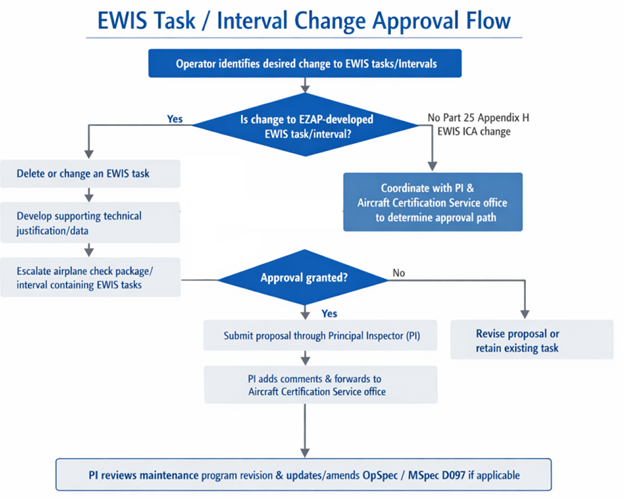
Logic flow for operators to EZAP-developed tasks and intervals as identified in Rev B.
Recommended Actions and Compliance Checklist
The checklist below is written as “do now” program-control actions that align with Rev B’s framing.
- Update program baselines and citations: Replace internal references to “AC 120-102A (Change 1)” with “AC 120-102B,” and ensure QA/audit checklists reflect Rev B section numbering and appendices.
- Normalize terminology and routing: Update internal procedures and work instructions to match Rev B’s “responsible Aircraft Certification Service office” terminology and Rev B’s PI-forwarding paths for changes requiring certification approval.
- Reconfirm Appendix H scope for affected fleets and projects: For fleets or STCs where § 25.1729 is in the certification basis (or invoked via § 21.101), explicitly map ICA deliverables to H25.4/H25.5 and document how mandatory replacement times (if any) are controlled in the operator program.
- Validate EWIS ICA traceability controls: Ensure the operator tracking system and controlling reference number correlation are implemented and auditable across maintenance programs, manuals, job cards, and engineering orders/authorizations.
- Codify change control logic: Make sure internal governance distinguishes (a) task deletion/modification requiring Aircraft Certification Service approval vs (b) check-package escalation typically handled under PI authority, and preserves the technical justification expectations in both cases.
- Training program refresh: Confirm EWIS training materials align to AC 120-94’s target-group approach, and validate recurrent/refresher training strategy against AC 120-94 guidance (including the suggested 2-year refresher cadence where adopted).
Conclusion and Next Steps
AC 120-102B replaces AC 120-102A and modernizes the FAA’s operator guidance for EWIS ICA incorporation by tightening the legal framing of AC usage, updating oversight terminology and contact pathways, and most importantly for certification-sensitive programs, clarifying the Appendix H scope of § 25.1729 EWIS ICA (H25.4 and H25.5) and surfacing “mandatory replacement times” as an explicit element of the § 25.1729 context.
Those who maintain a Part 121/129 EWIS program, the latest revision of AC 120-102, should consider:
- Verifying the traceability/document control, and
- Revalidate the approval/change-control workflow used when EWIS tasks or intervals are revised.
When considering the Part 25 certification or STC activities, Rev B’s compatibility cross-references checklist should be integrated into the design/maintenance activities to ensure EWIS ICA deliverables are both compliant and operationally adoptable. Doing this should help to reduce downstream issues when operators incorporate and maintain them for decades.
Those in need of support for these programs, or interested in finding out more about the EWIS training offered, contact Lectromec. Our staff of trained EWIS engineers will be able to help.

Michael Traskos
President, Lectromec
michael.traskos@lectromec.comMichael has been involved in the field of EWIS for more than two decades and has worked on a wide range of projects from basic component testing, aircraft certification, and remaining service life assessments. Michael is an FAA DER with a delegated authority covering EWIS certification, the former chairman of the SAE AE-8A EWIS installation committee, and current vice chairman of the SAE AE-8D Wire and Cable standards committee.