
PMA Approval for EWIS Components: What to Resolve Before Testing Begins
A Parts Manufacturer Approval (PMA) project for an electrical wiring interconnection system (EWIS) component can appear straightforward. A replacement wire, connector, contact, splice, terminal, clamp, or harness may fit the same installation and may even reference the same industry specification as the original. That does not, by itself, establish an acceptable PMA showing.
Years ago, during in-person Designated Engineering Representative (DER) recurrent training, an instructor asked the group, “If I am replacing a part, is there anything wrong with using what I believe to be a better part?” Being young and naive, I answered, “No.” The instructor’s response was the more important question: “What is the basis for claiming that it is better, and do you understand the engineering decisions that led to the original part selection?” Obviously, the goal (which succeeded because I remember it ten years later) was that a replacement may improve one property while creating a weakness in another critical area.
That lesson is particularly relevant to EWIS. The challenge is not simply to find a component that looks the same or performs well in isolation. The PMA applicant must understand what characteristics matter to the approved installation and develop evidence showing that the replacement preserves the required level of airworthiness.
FAA PMA Responsibilities
FAA Order 8110.42D places responsibility on the PMA applicant to address several issues that should shape the project before a qualification program is finalized:
- Identify installation eligibility.
- Show that the component performs its intended function.
- Assess the consequences of failure.
- Establish the applicability of instructions for continued airworthiness.
- Maintain an appropriate quality system.
- Provide for continued operational safety.
For EWIS components, these are not administrative steps to complete after testing. They establish what the replacement must do, where it may be installed, what failures matter, and what evidence will be needed to support approval.
Difficult Duplicate
EWIS component performance is often controlled by characteristics that are not obvious from an external inspection. Two components that meet the same broad specification or have nearly identical dimensions can still differ in ways that affect aircraft performance.
The component must also be evaluated as part of an installation. An electrical contact may meet a standalone resistance requirement but behave differently after vibration or at operating temperature. A wire may pass dielectric testing but be unsuitable for a wet, high-vibration routing zone. The FAA EWIS guidance emphasizes that component qualification must satisfy the design requirements and that the component must be selected and used within the aircraft constraints associated with its location.
This is why the question “Is the replacement better?” is usually the wrong starting point. The better question is: “Does the replacement preserve the performance characteristics that matter to this installation?”
Approval Basis: Identicality or Tests and Computations
FAA Order 8110.42D identifies two fundamental design-approval paths:
- Show that the PMA design is identical to approved type-design data; or
- Use tests and computations to show compliance with the airworthiness requirements applicable to the affected product.
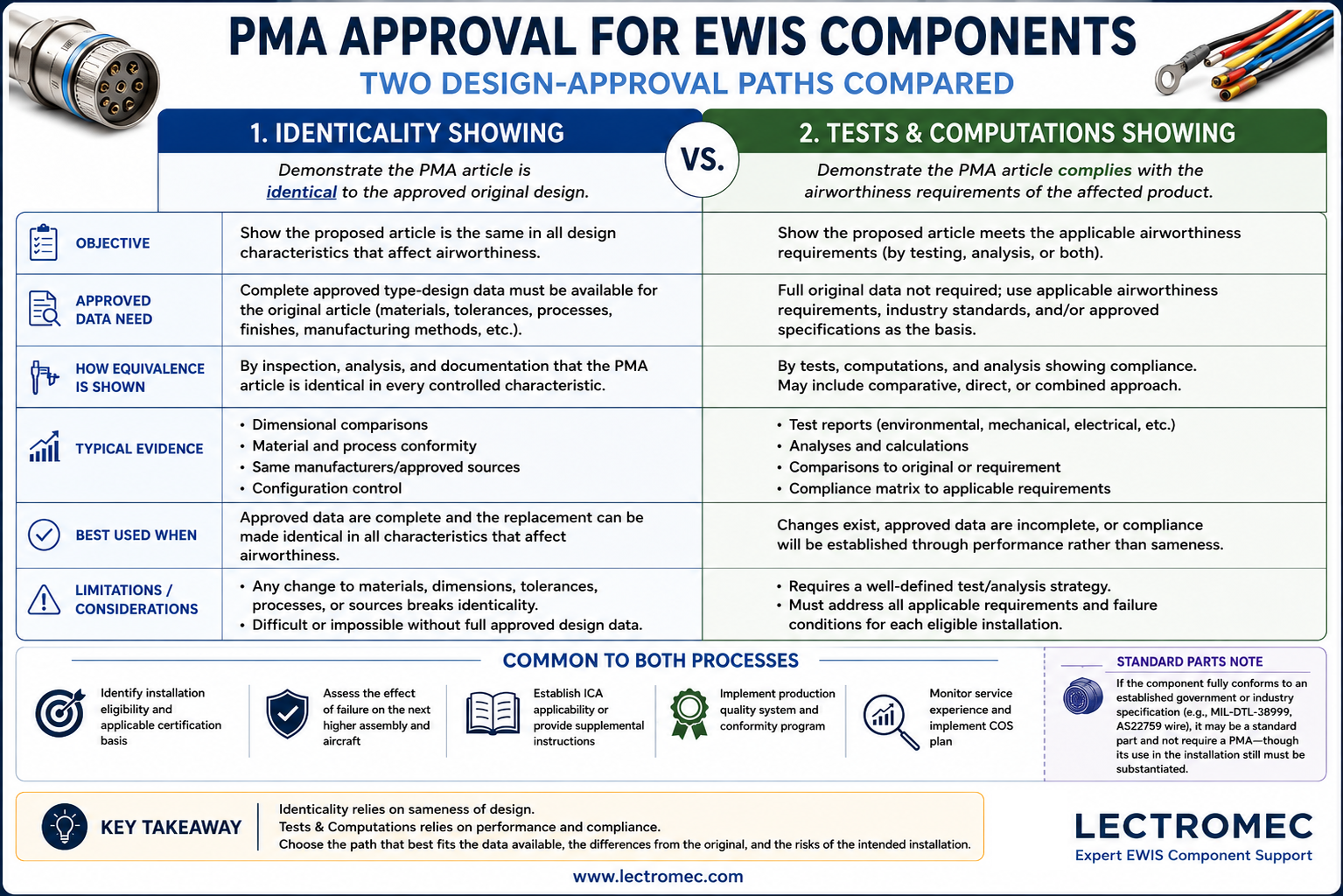
Showing that a replacement is identical is demanding. “Identicality” is not established merely because the replacement has the same dimensions, fits the same interface, or is manufactured to a similarly titled specification. The applicant needs data sufficient to establish the relevant design characteristics, including materials, tolerances, manufacturing processes, and other controlled features that can affect airworthiness.
To support this point, FAA AC 21.303-4 cautions that dimensional analysis alone is usually inadequate for reverse-engineered components. Representative, traceable samples and consideration of original-part variability are necessary when the design must be characterized. If the applicant does not have the approved design data needed to establish identicality, a tests-and-computations approach is generally the more appropriate path.
Standard Parts
EWIS projects add another important question: Does the proposed component require its own PMA at all? The FAA guidance defines a standard part as a part manufactured in complete compliance with an established industry or U.S. Government specification that includes the design, manufacturing, test and acceptance criteria, and uniform identification requirements necessary to produce and conform the part. When a component truly meets that definition, §21.9 provides a separate regulatory basis for producing it, and the standard part does not require its own PMA.
This can apply to common aerospace EWIS components such as MIL-DTL-38999 connectors, AS39029 contacts, AS22759 wire, and other specification-controlled parts when they are produced in accordance with the governing specification and applicable qualification requirements.
The distinction is important because a project team can otherwise spend significant effort developing a PMA showing for a component that already qualifies as a standard part.
Standard Part ≠ Interchangeable
Use of a standard-part status answers one question (whether the component itself can be produced under the standard-part provisions), but it does not automatically answer the second question regarding acceptable substitution in a specific aircraft installation. For example, a PMA applicant may propose replacing a proprietary OEM connector with a MIL-DTL-38999 connector, but just because the proposed connection is included in the QPL, does not establish that the proposed connector performs the required function in the intended installation. Depending on the application, that evaluation may include comparison of electrical, mechanical, thermal, and environmental performance.
The point is that standard-part status establishes a basis for producing the component; it does not, by itself, establish interchangeability with another article or even that it is a quality part.
The boundary standard and interchangeable parts become even more important when a nominally standard component has been modified or subjected to requirements beyond the governing specification. Special plating, proprietary screening, additional environmental qualification, unique dimensional controls, potting, machining, or other aircraft-specific requirements may mean that the resulting article is no longer simply the standard specification part.
AC 21.303-4 notes that if a production approval holder purchases a standard part, applies more restrictive inspection criteria, and assigns a new part number, the component is no longer treated simply as the standard part. This is common territory for EWIS, where an OEM part number may represent a specification-controlled component plus additional source, inspection, or performance requirements.
Standard Parts Within a PMA Assembly
The same distinction applies when a PMA article is an assembly. Consider a replacement wire harness that incorporates AS22759 wire, AS39029 contacts, and MIL-DTL-38999 connectors. The PMA applicant does not normally need to obtain a separate FAA production approval for each standard component. Instead, the PMA design can identify and control those parts by their applicable specifications and part numbers while the applicant substantiates the design and performance of the completed harness.
A practical drawing package should clearly separate standard components from PMA-controlled design features. The PMA-controlled features may include wire lengths, routing, branch locations, termination configuration, shielding architecture, assembly processes, identification, and other characteristics that define the completed harness.
Finally, the completed assembly must still demonstrate its intended function and suitability for each eligible installation. This returns to the core idea of the PMA process for EWIS: Standard parts are building blocks within the approved design; they do not replace the applicant’s responsibility for the airworthiness of the final PMA article.
From Approval Basis to Qualification Program
Once the project team has established whether the component is a standard part, whether a substitution is being proposed, and whether the PMA showing will rely on identicality or tests and computations, the qualification program can be focused on the characteristics that matter.
The practical sequence should be to:
- Identify the eligible installations and their requirements,
- Determine the relevant component characteristics and failure modes,
- Identify any differences between the approved and proposed articles, and
- Select analysis or testing that closes those differences.
Following this sequence prevents the qualification program from becoming a collection of familiar component tests with no clear connection to the certification showing. When developing the test scope, it should be driven by the intended function, the installation environment, and the consequences of failure, not simply by what tests are available in a component specification.
This also helps keep testing within the scope of the PMA activity. Where a standard part already establishes certain characteristics, the applicant may be able to rely on that controlled specification rather than recreate qualification evidence unnecessarily. Furthermore, where the proposed use differs from the approved installation or introduces new requirements, additional substantiation may be needed.
Care should be taken to avoid trying to perfectly align qualification testing with aircraft level tests that are called out in standards like DO-160. Many of the tests identified for EWIS components were created because of field or production failures and have been included to prevent similar failures.
Obsolescence
The last note on this area: obsolescence. Although obsolescence management falls outside the formal PMA approval process, it is still worth considering when selecting replacement EWIS components. Choosing parts that remain supported by active industry or government standards can reduce long-term supply risk, preserve access to multiple qualified sources, and make future substitutions or repairs easier to manage. A component tied to an obsolete or narrowly supported specification may satisfy the immediate certification need but create future problems if materials, tooling, manufacturers, or qualification infrastructure disappear. Where several technically acceptable replacement options exist, the preference for components governed by active standards can provide a practical lifecycle benefit, improving availability, maintaining clearer configuration control, and reducing the likelihood that another redesign or approval effort will be required simply because the selected part becomes difficult to procure.
Conclusion
The central PMA question for an EWIS component is not, “Does the replacement part fit and pass a specification?” The more complete question is, “Does the body of design data, analysis, testing, production control, maintenance information, and service monitoring show that this component will preserve the airworthiness of every eligible installation?”
Answering that question requires a full life-cycle view of the component. The applicant must first understand the installation and determine the correct regulatory basis: identicality, tests and computations, or—in the case of a standard part—whether a separate PMA is needed for the component at all. From there, the applicant can distinguish standard-part attributes from aircraft-specific requirements, identify what must be substantiated, and develop a focused qualification program.
That sequence reduces unnecessary testing and helps avoid the opposite problem: assuming that compliance with an industry or military specification automatically establishes acceptability for an aircraft-specific substitution. The goal is not simply to show that the replacement component is good. It is to show that it is appropriate for the approved installation.