
EWIS regulatory compliance with 25.1707, Part II
This is the second article in a series on EWIS Regulatory Compliance. The series is looking at the individual components of the Federal Aviation Administration (FAA) EWIS regulations 25.1707. The first article covered section 'a' of the regulations.
Continuing the examination of the FAA EWIS separation requirements detailed in 25.1707, this article examines the next part of the regulation dealing with EMI. The second paragraph from FAA regulation 25.1707 focuses on electrical interference and addressing this from the wire system level. The regulation states:
(b) Each EWIS must be designed and installed so that any electrical interference likely to be present in the airplane will not result in hazardous effects upon the airplane or its systems.
According to the FAA’s guidance document on this regulation (25.1701-1), the following sources for EMI should be considered with regard to how they affect the EWIS:
- Electrical noise generated from equipment connected to the bus bars
- Electrical coupling or cross-talk between electrical cables
- Electrical coupling between cables and aerial feeders
- Electrical equipment operating out of spec or malfunctions generating EMI
- Parasitic eddy currents and voltages in the EWIS and grounding systems
- The effects of lightning currents
- The effects of static discharge
- Dissimilar frequencies between electrical generation system and other systems
In the following example, there are three harnesses: two of which are power carrying harnesses (blue), and a signal harness (cyan). In this design the signal harness is identified to be within 2inches of the closest power carrying harness. The interference from the power cables was investigated and determined to be have no effect on the shielded cables in the signal harness.
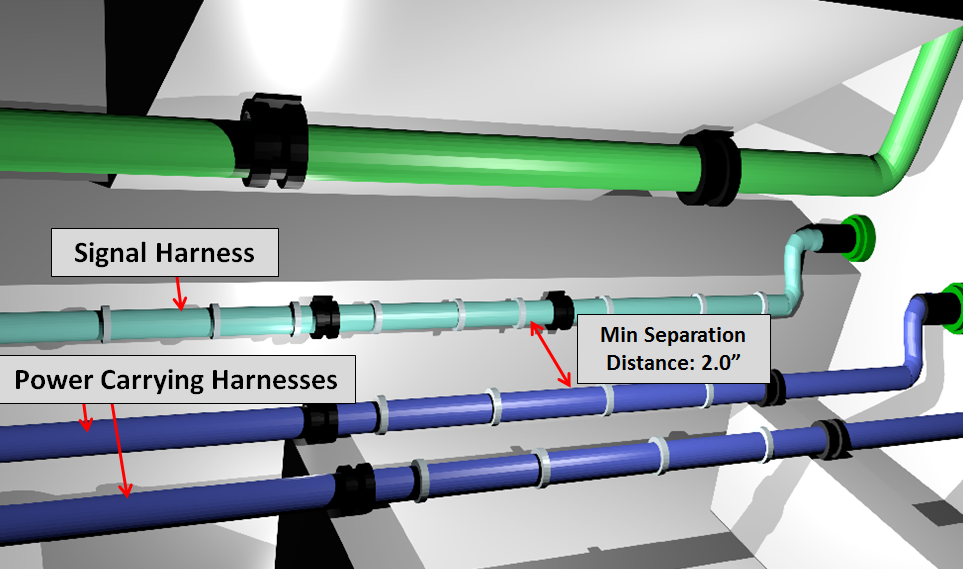
If, in this case, the cable shielding was not sufficient to protect the signals, then additional methods for protection would need to be considered.
In particular, the systems that are necessary for continued safe flight, landing, and egress should be given the highest priority when assessing the EMI impact. The following are methods for protecting systems from EMI and are common practice for aerospace platforms:
- Use of EMI/EMP filter protect ion connectors.
- If possible, route power and signal wires through separate connectors.
- Shielded cables should be considered for signal cables. Those flight/safety critical systems dependent on clean signal may need this type of shielding for additional noise reduction. When selecting a shielded construction, it is important to ensure that the EMI range suppressed protects the wire’s signal.
- There are harness protection schemes that offer EMI shielding. As with other shielding techniques, before considering this option, it is important to determine the shield grounding.
- Separate power wires from signal harnesses. This design choice may not be possible in some scenarios, particularly in areas where space is limited.
The reason for this requirement is that EMI can have as devastating impact on aircraft systems as electrical arcing. It is important to consider the factors when designing your EWIS, or installing new equipment in the aircraft.
The next article will address the requirements on heavy current carrying wires.