
Circuit Protection Selection Guidance
Circuit protection devices have existed since 1864; one would think that selection of circuit protection would be a straight forward task. However, it is not. NASA developed a seven-step process for circuit protection selection and both EN3179 and AS50881 provide some guidance.
In a past article, Lectromec began to consider the differences between two major EWIS standards in aerospace; AS50881 and EN3197. This article reviews these standards and how they address circuit protection selection.
EN3197
EN3197 contains good guidance on selection criteria and principles to achieve a safe and properly functioning system.
Criteria
The following are important criteria to live by when selecting the correct part for circuit protection:
- The circuit protection chosen should prevent overload of the most sensitive Electrical Wiring Interconnection System (EWIS) component within the circuitry.
- The circuit protection should protect the EWIS rather than the equipment, the equipment should be protected separately.
- Any protection device must be “trip free” so that there is no override facility that allows a circuit overload to be maintained.
- The part should be “fail safe” so that hidden defects do not affect performance.
System Level Guidance
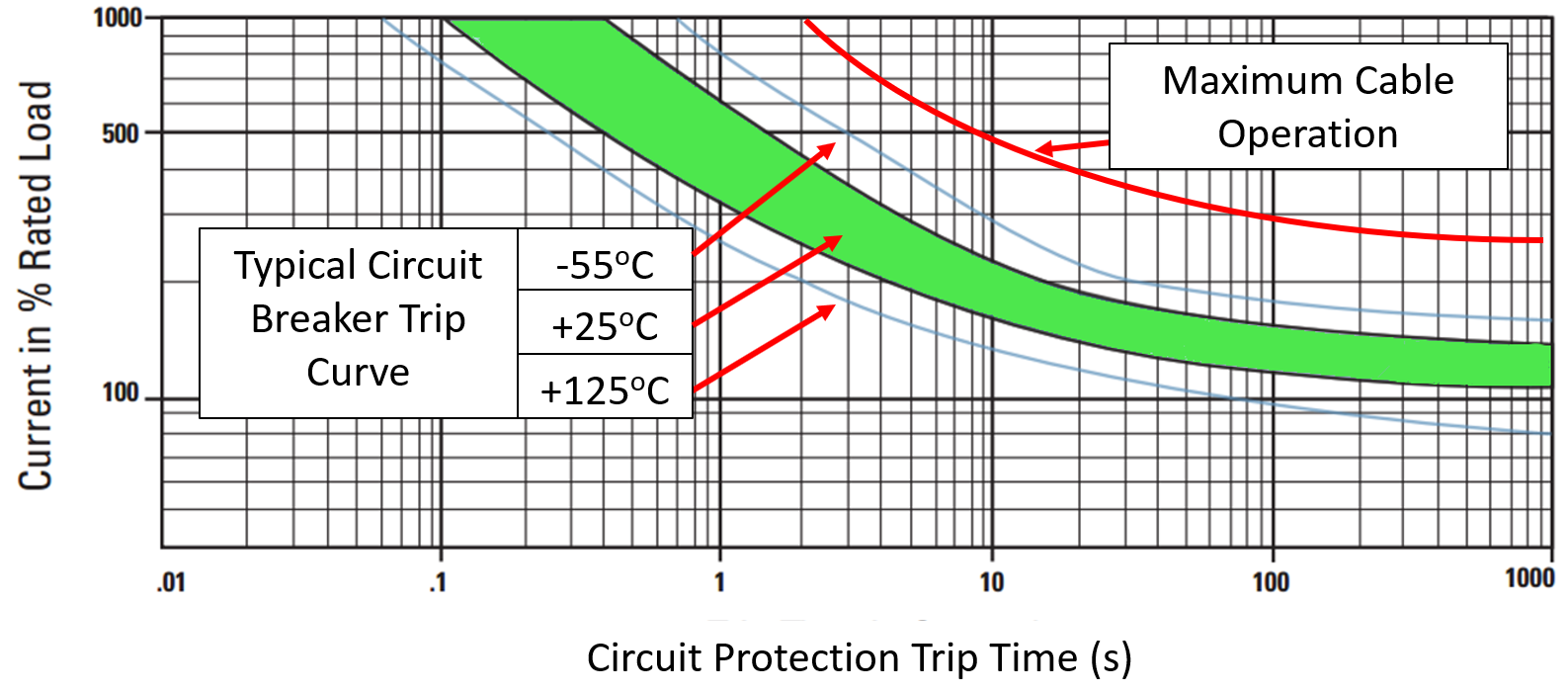
For a circuit protection device to work effectively, it must trip prior to reaching the maximum component current rating. For example, if it is determined that the maximum current allowed on a cable for a given time duration is given by the curve in red in the figure, then the circuit breaker tripping curve should be at a lower current threshold everywhere along the curve. The most sensitive (lowest maximum current rating) EWIS component in the system should set the expected circuit protection performance. To do this analysis, one needs to determine the wire’s/cable’s current carrying capacity that can be carried through different wire and cable harness designs.
Specific Failure Mode Guidance
There are several failure modes defined and considered in EN3197 whose effect on the system may be mitigated by appropriate circuit protection. Possible failure phenomena are defined in EN3197 are shown in the table below. Mitigation of many of these failure modes are handled by wire selection and wires are required to be specifically tested. The test methods generally call for thermal breaker type circuit protection, but other circuit protection technologies are acceptable [link].
Circuit protection selection and wire selection should go hand in hand to mitigate risk. System level testing is invaluable in determining the system failure event behavior. The test methods associated on the arcing phenomena are generally focused on wire selection and not on circuit protection selection; this could be an area of improvement in both standards. In addition to aiding in circuit protection selection, the test standard could be established to certify performance.
|
Failure Mode |
Relation to Circuit Protection |
|
Short Circuit |
Circuit protection should trip in the event of a hard short. |
|
Wire selection and testing is used generally to mitigate the effect of this type of failure in the circuit. Thermal breakers are used as the circuit protection device. |
|
|
If a breach in the insulation is near a breach on an adjacent line, moisture can be a means of conduction between the lines. This can occur for long periods of time without tripping the circuit protection and can also develop into a more violent arcing scenario. |
|
|
Dry Arc Tracking |
This can be caused by vibration of an exposed wire conductor with a conducting structure. It may not trip a conventional circuit breaker or may take a long time to trip causing significant damage. |
Circuit Protection Selection Guidance
The EN3197 test method also provides guidance on many of the possible circuit protection technologies that may be used in the system. These include the following: circuit breakers, arc fault circuit interrupters, arc fault circuit breakers, remote control circuit breakers, solid state circuit breakers, residual current circuit breakers, and fuses [described here link].
These technologies have been developed to mitigate varying failure possibilities in the system. Arc fault circuit breakers, for example, can significantly decrease the duration of an electric arc compared to conventional circuit breakers thereby greatly limiting the arc damage risk [link].
AS50881 Circuit Protection Guidance
In contrast, AS50881 has sparse guidance on circuit protection that may be summed up as follows:
- Wires shall be sized so that they have capacity which is equal or greater than the circuit protection rating under all operating conditions.
- Circuits shall be powered with a single operating current interrupt system. Circuit protection shall not be paralleled or ganged together to achieve a specific current rating.
AS50881 could benefit substantially from guidance found in EN3197.
Conclusion
Modern circuit protection technologies can provide considerable benefits including mitigation of potential failure risk. Those seeking guidance on the best practices in selection of circuit protection should consider reviewing the applicable sections in the EN 3197 standard. Further, the AS50881 could benefit from incorporation of guidance included in the European standard.