View Latest Blog Entries
Close
Categories
Testing & Assessment Standard & Regulation Certification Aging Wires & Systems Maintenance & Sustainment Protection & Prevention Management Conference & Report Research Miscellaneous Arcing
Popular Tags
Visual Inspection High Voltage AS50881 MIL-HDBK MIL-HDBK-525 FAR Electromagnetic Interference (EMI) AS4373 Maintenance FAR 25.1707 Degradation Wire System
All Tags in Alphabetical Order
2021 25.1701 25.1703 3D print abrasion AC 33.4-3 AC 43 Accelerated Aging accessibility Additive Manufacturing ADMT Aging Systems AIR6808 AIR7502 Aircraft Power System aircraft safety Aircraft Service Life Extension Program (SLEP) altitude Aluminum arc damage Arc Damage Modeling Tool Arc Fault (AF) Arc Fault Circuit Breaker (AFCB) Arc Resistance Arc Track Resistance Arcing Arcing Damage AS22759 AS22759/87 AS23053 AS29606 AS39029 AS4373 AS4373 Method 704 AS50881 AS5692 AS6019 AS6324 AS81824 AS83519 AS85049 AS85485 AS85485 Wire Standard ASTM B230 ASTM B355 ASTM B470 ASTM D150 ASTM D2671 ASTM D495 ASTM D8355 ASTM D876 ASTM F2639 ASTM F2696 ASTM F2799 ASTM F3230 ASTM F3309 ATSRAC Attenuation Automated Wire Testing System (AWTS) Automotive Avionics backshell batteries bend radius Bent Pin Analysis Best of Lectromec Best Practice bonding Cable Cable Bend cable testing Carbon Nanotube (CNT) Certification cfr 25.1717 Chafing characteristic impedance Chemical Testing Circuit Breaker circuit design Circuit Protection cleaning clearance Coaxial cable cold bend collision comparative analysis Completed Harness Compliance Component Selection Condition Based Maintenance Conductor Conductor Testing conductors conduit Connector connector contacts Connector Durability Connector Failure Modes connector installation Connector rating connector selection connector testing connectors contacts Corona Corrosion Corrosion Preventing Compound (CPC) corrosion prevention Cracking creepage Custom component D-sub data analysis data cables degradat Degradation Delamination Derating design safety development diagnostic Dielectric breakdown dielectric constant Dimensional Life disinfectant Distributed Power System DO-160 dry arc dynamic cut through E-CFR electric aircraft Electrical Aircraft Electrical Component Electrical Power Electrical Testing Electrified Vehicles Electromagnetic Interference (EMI) Electromagnetic Vulnerability (EMV) Electrostatic Discharge EMC EMF EMI EN2235 EN3197 EN3475 EN6059 End of Service Life End of Year Energy Storage engines Environmental Environmental Cycling environmental stress ethernet eVTOL EWIS certification EWIS Component EWIS Design EWIS Failure EWIS sustainment EWIS Thermal Management EZAP FAA FAA AC 25.27 FAA AC 25.981-1C FAA Meeting failure conditions Failure Database Failure Modes and Effects Analysis (FMEA) FAQs FAR FAR 25.1703 FAR 25.1707 FAR 25.1709 Fault fault tree Filter Line Cable Firewall Fixturing Flame Resistance Flammability fleet reliability Flex Testing fluid exposure Fluid Immersion Forced Hydrolysis fuel system fuel tank ignition Functional Hazard Assessment functional testing Fundamental Articles Fuse Future Tech galvanic corrosion Glycol Gold Gold plating Green Taxiing Grounding hand sanitizer handbook harness construction Harness Design harness installation harness protection hazard Hazard Analysis health monitoring heat shrink heat shrink tubing high current high Frequency high speed data cable High Voltage High Voltage Degradation High Voltage Systems HIRF History Hot Stamping Humidity Variation HV connector HV system ICAs IEC 60851 IEC60172 IEEE immersion impedance insertion loss Inspection installation installation safety Instructions for Continued Airworthiness insulating material insulating tape Insulation insulation breakdown insulation resistance insulation testing interchangeability IPC-D-620 ISO 17025 Certified Lab ISO 6722 ISO 9000 J1673 Kapton Laser Marking life limit life limited parts Life prediction life projection Lightning lightning protection liquid nitrogen lithium battery lunar Magnet wire maintainability Maintenance Maintenance costs Mandrel mean free path measurement mechanical stress Mechanical Testing MECSIP MIL-C-38999 MIL-C-85485 MIL-DTL-17 MIL-DTL-22992 MIL-DTL-23053E MIL-DTL-3885G MIL-DTL-38999 MIL-E-25499 MIL-F-5372 MIL-HDBK MIL-HDBK-1646 MIL-HDBK-217 MIL-HDBK-454 MIL-HDBK-516 MIL-HDBK-522 MIL-HDBK-525 MIL-HDBK-683 MIL-HDBK-863 MIL-M-24041 MIL-STD-1353 MIL-STD-1560 MIL-STD-1798 MIL-STD-464 MIL-T-7928 MIL-T-7928/5 MIL-T-81490 MIL-W-22759/87 MIL-W-5088 MIL–STD–5088 Military 5088 modeling moon MS3320 NASA NEMA27500 Nickel nickel plating No Fault Found OEM off gassing Outgassing Over current Overheating of Wire Harness Parallel Arcing part selection Partial Discharge partial discharge at altitude Performance physical hazard assessment Physical Testing polyamide polyimdie Polyimide-PTFE polyurethane Potting Power over Ethernet power system Power systems predictive maintenance Presentation Preventative Maintenance Program Probability of Failure Product Quality PTFE pull through quadrax Radiation Red Plague Corrosion Reduction of Hazardous Substances (RoHS) regulations relays Reliability removable contact Research Resistance Revision C Rewiring Project Risk Assessment S&T Meeting SAE SAE Committee SAE J1127 SAE J1128 Sanitizing Fluids schematic Scrape Abrasion Secondary Harness Protection separation separation distance Separation Requirements Series Arcing Service Life Extension Severe Wind and Moisture-Prone (SWAMP) Severity of Failure shelf life Shield Shielding Shrinkage signal signal cable signal reflection Silver silver plated wire silver-plating skin depth skin effect Small aircraft smoke Solid State Circuit Breaker Space Certified Wires Splice standards Storage stored energy superconductor supportability Sustainment System Voltage Temperature Rating Temperature Variation Test methods Test Pricing Testing testing standard Thermal Circuit Breaker Thermal Endurance Thermal Index Thermal Runaway Thermal Shock Thermal Testing tin Tin plated conductors tin plating tin solder tin whiskering tin whiskers top 5 Transient Troubleshooting TWA800 UAVs UL94 USAF validation verification video Visual Inspection voltage voltage differential Voltage Tolerance volume resistivity vw-1 WAIC wet arc white paper whitelisting Winding wire Wire Ampacity Wire Bend Wire Certification Wire Comparison wire damage wire failure wire performance wire properties Wire System wire testing Wire Verification Wireless wiring components wiring diagram work unit code

Comparison of MIL-DTL-38999 and MIL-DTL-22992

Standard & Regulation

Key Takeaways
  • Different qualification standards exist to address the different application demands of EWIS components
  • Some test methods between standards have different titles or methodology but align in intent.
  • Many standards exist for qualifying EWIS components – often the best qualification plans include aspects of several different standards.

In aviation Electrical Wiring Interconnection Systems (EWIS), the MIL-DTL-38999 is nearly synonymous with connector testing. The standard is comprehensive, robust, and serves as a good test reference for nearly any electrical connector, even those that do not align with the entire standard. Connectors qualified to the 38999 are considered suitable for rather extreme aviation environments, namely: high vibration areas, SWAMP environments, and even within weapons systems. Because of its robustness, the test/performance requirements of the MIL-DTL-38999 can sometimes be too restrictive for less intense aircraft environments (such as commercial or low-altitude aircraft) or for EWIS connectors that do not align with the construction of MIL-DTL-38999’s “miniature, high density, circular, environment resistant electrical” connectors.

In these cases, other standards may be considered to more closely align with the anticipated needs of an aircraft’s EWIS. In this article, we will compare the well-known MIL-DTL-38999 with a much less restrictive standard, MIL-DTL-22992, and identify many similarities and gaps between the two standards.

Basic Differences

Some of the most obvious differences between standards include the scope and intended use cases of each standard.

MIL-DTL-38999

MIL-DTL-22992
Temperature Range
-65°C to 200°C
-55°C to 125°C
Minimum Contact Size
23
16
Maximum Contact Size
8
0000
Construction
  • Miniature, high density, circular, environment resistant electrical connectors with removable crimp contacts
  • Hermetically sealed electrical connectors with fixed non-removable contacts
  • Multi-contact, heavy duty, quick disconnect, waterproof, electrical plug and receptable connectors and associated accessories
Plug Types
  • Straight, without spring fingers
  • Straight, with spring fingers that electrically engage receptacle shell prior to contact engagement (series I, III and IV only)
  • Straight, with spring fingers that electrically engage receptacle shell after contacts engage (series II only)
  • Lanyard release
  • Cable connecting plug (without coupling ring)
  • Straight plug
Receptacle Types
  • Box mounting, both front and rear panel mounting
  • Wall mounting, both front and rear panel mounting
  • Jam nut, rear panel mounting
  • Solder mounting
  • Thru-bulkhead
  • Wall mounting receptacle
  • Box mounting receptacle
  • Jam nut receptacle
  • Jam nut receptacle (box)
  • Wall mounting receptacle (with coupling ring – class L only)
Use Cases
  • Series I – General application within weapon system; high vibration, SWAMP
  • Series II – General application within weapon system; not high vibe or SWAMP; not scoop proof
  • Series III – General application within weapon system; blind mating areas; high vibe at elevated temp; SWAMP
  • Series IV – General application within weapon system; blind mating areas; high vibe at elevated temp; SWAMP
  • Class C – External interconnection on vans, shelters, trailers, building, heavy duty applications – not for primary power distribution
  • Class J – Same as class C but where a wire support grommet is necessary
  • Class L – Power connections 40-200A, heavy duty, waterproof, arc-quenching. For use only with heavy-duty jacketed cables
  • Class R – General purpose, heavy duty; pressurization and arc quenching not required – not for primary power distribution

Notably, the MIL-DTL-22992 lacks considerations for altitude, flame testing, and thermal aging methods. This is not too surprising given the significantly less severe environments the standard addresses, but it is important to keep in mind these gaps when using MIL-DTL-22992 for connector qualification testing.

Test Alignment

There are a limited number of test methods between MIL-DTL-38999 and MIL-DTL-22992 that align with one another to varying degrees of accuracy. The following table provides a simplified comparison of tests common between both standards.

Test

Referenced Methods

38999

22992

38999

22992

Air Leakage

EIA-364-02

None

  • Hermetic only
  • 30 min unspecified conditioning
  • Test pressure differential 1atm
  • 30 min conditioning at -55oC for classes C and J
  • Connector test pressure differential ~ 2atm
  • Protective cover test pressure differential ~1 atm
  • Allowable leakage much greater (by a factor of ~104)

Insulation Resistance

EIA-364-21

EIA-364-21

  • Performed at ambient or elevated temperature
  • Minimum ambient temperature requirement: 5,000 MΩ (requirement varies after Humidity and Altitude Immersion testing and at elevated temperature)
  • Ambient temperature only
  • Minimum requirement: 5,000 MΩ

Insert Retention

EIA-364-35

None

  • Load application rate: 10 psi/s
  • Test load: 100 psi
  • Test load maintained for 5-10s
  • Load application rate: 10 psi/s
  • Test load varies by connector size
  • Test load maintained for 5s

Dielectric Withstanding Voltage

EIA-364-20

EIA-364-20

  • Performed at sea level or altitude
  • All contacts tested
  • Test voltage varies based on service rating (sea level values: 1-2.3kVAC)
  • Performed at sea level only
  • Voltage applied between the two closest contacts and between the shell and contacts closest to the shell
  • Test voltage varies based on service rating (1-7kVAC)

Salt Spray

EIA-364-26

EIA-364-26

  • Standard test and dynamic test methods
  • Some duration alignment with 22992
  • 50 mating/demating cycles before and after salt spray (dynamic)
  • Aligns more closely with 38999 dynamic test – exposure with ends mated followed by shorter exposure unmated
  • Some duration alignment with 38999
  • 50 mating/demating cycles before and after salt spray

Contact Resistance

EIA-364-06

EIA-364-06

  • Higher maximum voltage drop requirement (for sizes covered by both standards)
  • Lower maximum voltage drop requirement (for sizes covered by both standards)

Hexavalent Chromium Detection

IEC 62321-7-1

IEC 62321-7-1

  • Same method
  • Same requirement
  • Same method
  • Same requirement

Magnetic Permeability

EIA-364-54

ASTM A342

  • Measured by Lo Mu permeability indicator
  • Relative permeability less than 2.0μ
  • Measured by Lo Mu permeability indicator
  • Relative permeability less than 2.0μ

Shell-to-Shell Conductivity

EIA-364-83

EIA-364-83

  • Same test method
  • Maximum voltage drop ranges from 1.0 mV to 200 mV depending on connector properties/construction
  • Max voltage drop may increase by 100% after conditioning
  • Same test method
  • Maximum voltage drop before conditioning: 200mV
  • Max voltage drop may increase by 100% after conditioning

Contact Retention

EIA-364-29

None

  • Force applied alternately in each axial direction
  • Test load maintained for 6 seconds
  • Greater test loads (for sizes covered by both standards)
  • Force applied alternately in each axial direction
  • Duration of force application not specified

High Impact Shock

MIL-DTL-901

MIL-STD-202-207

  • No electrical discontinuity
  • Drop heights of 1, 3, and 5 ft
  • No electrical discontinuity in excess of 10 µs
  • Drop heights of 1, 3, and 5 ft

Humidity

EIA-364-31

MIL-STD-202-106

  • 10 cycles (cold exposure inclusive)
  • Min insulation resistance during 10th cycle: 100MΩ
  • Post-test DWV
  • 10 cycles (no cold exposure)
  • Min insulation resistance during 10th cycle: 10MΩ
  • Post-test DWV

Fluid Immersion

EIA-364-10

None

  • 11 standard test fluids
  • Varying duration, temperature, and number of cycles for each exposure
  • Connectors may be mated or unmated as specified
  • 2 Test fluids: hydraulic fluid and lubricating oil
  • 20 hour exposure in each fluid, unmated

Contact Engagement and Separation Force

AS39029

EIA-364-37

  • Hermetic only
  • Different standards, same test procedure
  • Same separation force requirements
  • Lower maximum engagement force requirements
  • Different standards, same test procedure
  • Same separation force requirements
  • Higher maximum engagement force requirements

Resistance to Test Probe Damage

AS39029

EIA-364-25

  • Hermetic with sockets only
  • Max engagement force for size 16: 36 oz
  • Min separation force for size 16: 1.5 oz
  • Size 16 socket contacts only
  • Max engagement force: 36 oz
  • Min separation force: 1.5 oz

Vibration

EIA-364-28

EIA-364-28

  • No discontinuity or disengagement of mated connector ends
  • Test condition VI of EIA-364-28
  • No electrical discontinuity in excess of 10 µs
  • Test condition III of EIA-364-28

Similar Intent – Different Tests

Some test methods between the standards have different titles/methodology but align in intent. Typically, this is to account for the different expected use cases of each qualification standard.

An example of this is the MIL-DTL-38999’s Altitude Immersion and the MIL-DTL-22992’s Water Immersion methods. These methods seek to determine if the sample connector is vulnerable to water ingress. Both methods primarily consist of immersion in water, but the main difference is the altitude at which the test is performed. As mentioned above, altitude consideration is not a factor in MIL-DTL-22992. If the connector under test is expected to operate in water-laden conditions at altitudes well above sea level, the MIL-DTL-38999 test may be the preferred option for qualification, even if the connector is not intended for military combat applications.

Test Gaps

There are many MIL-DTL-38999 test methods that are not included in the MIL-DTL-22992 standard; this is unsurprising considering the different application severities identified by each standard. Arguably more interesting are the test methods unique to the MIL-DTL-22992:

  • Shell-to-Shell Contact Resistance Grounding – A voltage drop measurement exclusive to ‘arc-quenching’ connector grounding contacts.
  • Heat Rise – A four-hour rated DC current application after which the temperature of each terminal is measured.
  • Cable Pull-Out – An axially applied pull force evaluating the connector adapter’s ability to hold the cable in place without the assistance from the connector-to-contact attachment.
  • Arc Rupture – Repeated mating/demating of powered connector ends to evaluate any resulting arc damage
  • Tensile (Protective Cover Chain) – A tensile pull test to evaluate the protective cover attachment chain to resist external force applications.
  • Abrasion – Repeated cycles of abrasion applied to panels representing the finish/plating of the connector shell or accessory hardware.

As mentioned above, the MIL-DTL-22992 does not account for considerations of flame exposure, altitude, or thermal aging. This is demonstrated in the absence of familiar MIL-DTL-38999 tests such as Firewall, Altitude-Low Temperature, Thermal Shock, and Temperature Cycling. In circumstances where these properties may affect performance, MIL-DTL-22992 would not provide sufficient results to confirm connector quality for the application.

Arc Rupture
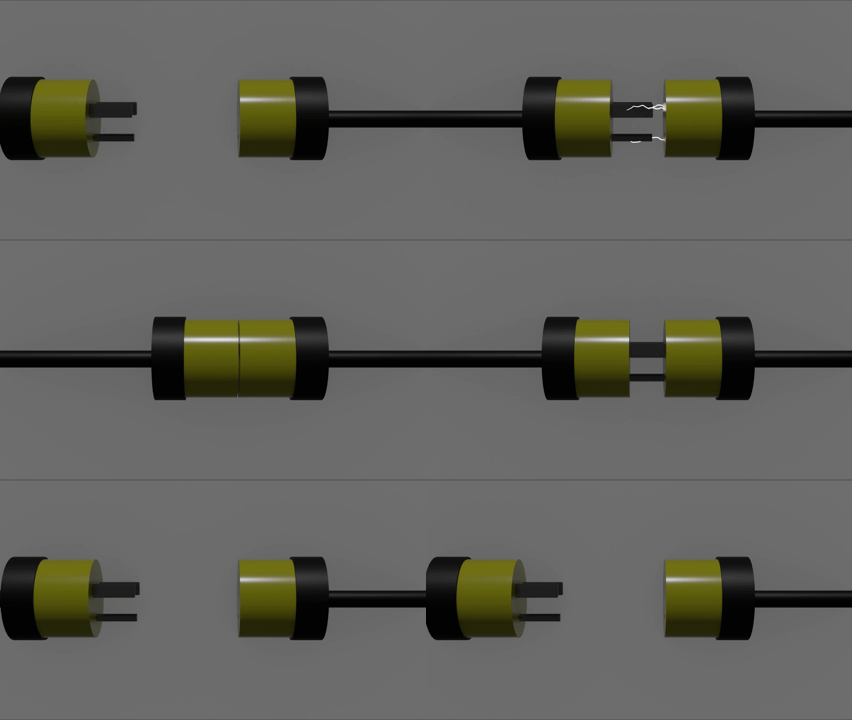
Arc Rupture test performance.

One method that stands out in the MIL-DTL-22992 is the Arc Rupture test. Put simply, connectors undergo 50 continuous mating/demating cycles while carrying test current. As the connector ends are separated and/or connected, the distance between mating electrical points varies. The closer each pin and socket are to one another, the more likely the air between the two will break down into an electrical arcing event (Picture the small electrical arcs that sometimes occur when plugging a device into a wall outlet, particularly when the device’s switch is in the “ON” position). Electrical arcs, even relatively small ones (in AIR6982 these are called “high impedance arcs” or “series arcs”), can result in equipment damage that will affect reliable functionality. The intent is to identify electrical and mechanical damage resulting from electrical arcs that would prevent the mating/demating of the connector ends by normal means.

There is no method in MIL-DTL-38999 with the same performance or intent as the Arc Rupture test of MIL-DTL-22992. Rather, the 38999 connectors are built with more robust coupling mechanisms and require more mechanical testing (Coupling and Uncoupling Torque, Durability, External Bending Moment, Bayonet Coupling Pin strength, etc.) to the extent that accidental demating of powered connectors is not considered a risk.

Conclusion

Ultimately, the planned testing conditions for EWIS components should represent the anticipated vehicle operations and environment. This may mean making changes to standard values or referencing any number of different standards. It is important to explore many testing options to develop a comprehensive qualification plan and ensure sufficient safety in the final aircraft design.

For those looking for guidance or testing regarding connector qualification, contact Lectromec today. Our ISO 17025:2017 accredited lab is ready to help.

Laura Wishart

Laura Wishart

Engineer, Lectromec

Laura has been with Lectromec since 2019 and has been a key contributor to projects involving testing of EWIS/fuel system failure modes, the impact of poor installation practices on EWIS longevity, and wire/cable certification testing. Her knowledge and attention to detail ensure consistent delivery of accurate test results from Lectromec’s lab.